Computational Art
Some Kind Of Graphical Physical Simulation (SKOGPS)

Progress, Updates, News

November 27, 2000 - 10:18am

I started with simple water droplets that fell down an image and diffracted the underlying image. This was boring.

I added a second effect called Lofticles. These are particles that float around the screen and are drawn towards motion. Motion is currently input as mouse movement. The particles have weight, they have color, and they leave pretty tails. Take a look at the screenshot.
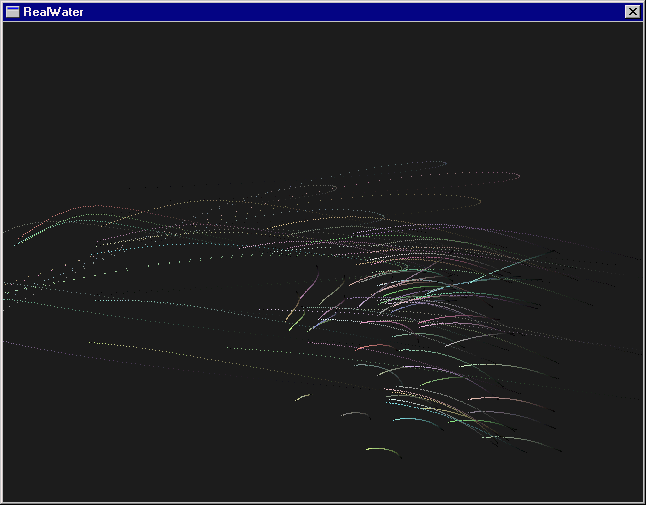
The mouse cursor, which did not appear in the screen capture, is in the lower-left corner. Also note that when the lofticles get moving very fast, they leave discontinuous tails. I intend to fix that.

Future Work

Instead of a simple gradient tail, make it big and showy. A trail of fire would be cool, or maybe puffs of smoke, or new particles. Also improve the physics of the particles. It's nice now, but they still don't respond very well and tend to get super-high velocities, which is bad. Oscillation from way off to the left to way off to the right and back happens a lot.

I need input from a video camera. The mouse cursor isn't a very accurate representation of motion from video input.


November 28, 2000 - 5:15pm

The lofticles look better. A lot better. The physics engine also behaves more smoothly; the lofticles are more responsive. I added 'invisible' walls to the screen so the things don't go flying off the visible window never to be seen again.

I did some minor optimizations on the blurry drawing routine, but there are still performance problems. Fortunately, I see plenty of areas for optimizations.

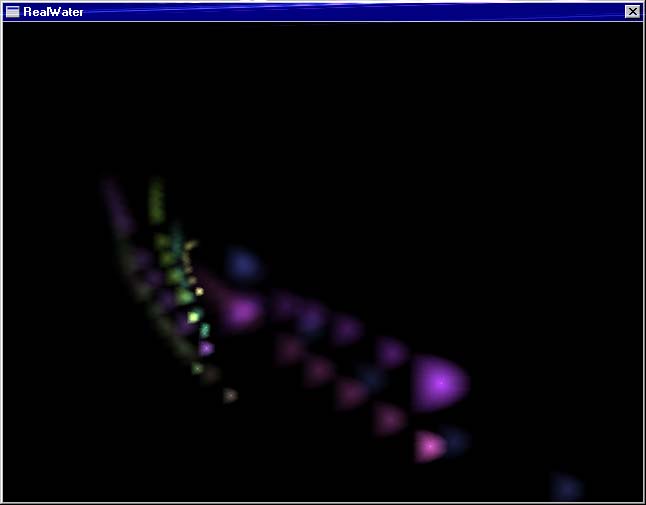
This screenshot shows the new particles - they are rather transparent and difficult to see.

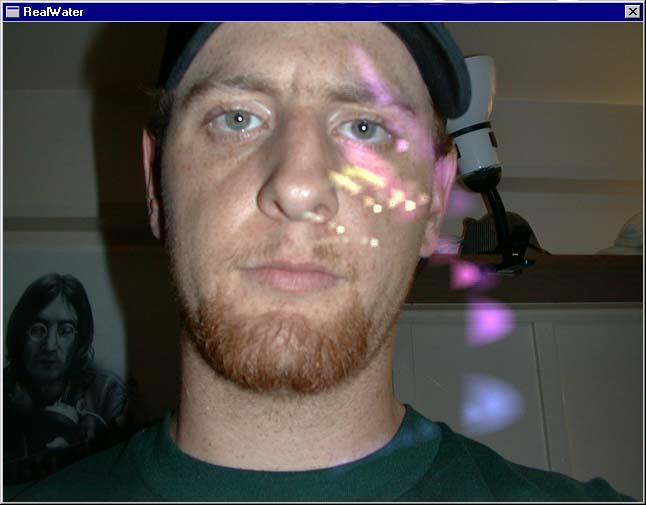
This screenshot is the same program but with an interesting background image.

These static screenshots really don't do the program justice.


December 5, 2000 - 3:30pm

I got my video capture card today. More to come!

December 11, 2000 - 4:50pm

Video card & capture card works. Resolution and contrast are poor with the camera, but it should work. Should I use Windows or switch to Linux? I'm not sure the Windows drivers allow enough flexibility. Screenshots of pictures and progress are coming soon.

I'm also thinking the projected image should not include the person. It could play a looping sequence of the background and just use the person's outline as data for the simulation. I think this might be cooler and would reduce the camera-shy factor.


Copyright © 2000 Kevin Goodier
Last modified 11.12.00